Trouble viewing in your email client? View web version.
|
Water Workforce Development Tribune
|
More Time to Launch Your Career in Water
|
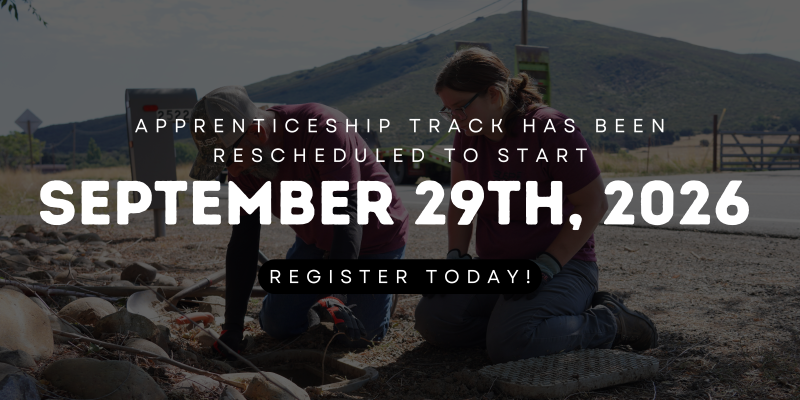
Good news for anyone considering a career in California's water and wastewater industry, there's now even more time to apply for the California Rural Water Association's (CRWA) Apprenticeship Program. The next apprenticeship track has been rescheduled to begin September 29, giving future apprentices additional time to take advantage of this unique career opportunity.
CRWA's Apprenticeship Program is designed to help participants build a rewarding career while earning a paycheck. Apprentices receive paid, hands-on training with experienced water professionals while completing Related Technical Instruction (RTI) that prepares them for long-term success in the industry.
Water and wastewater professionals play a vital role in protecting public health and ensuring reliable water service for communities across California. As the demand for skilled operators continues to grow, there has never been a better time to enter the field.
If you're looking for a stable, meaningful career with room to grow, don't miss this opportunity. Applications are still being accepted, and the next apprenticeship track begins September 29.
Learn more and apply today by contacting the CRWA Apprenticeship Team.
|
|
|
|
Upcoming Workforce Trainings
|
AB54
Distribution Certification Review 1-2
| August 19th - 20th, Tehachapi |
Clow Valve Training Event
Wastewater Math Review
Chlorine Gas Training
|
|
|
TRAINING SPOTLIGHT
|
|
August is packed with opportunities to sharpen your skills, earn continuing education credits, and stay up to date with industry best practices.
AB54
August 3rd | Online
This webinar-based course fulfills the two-hour AB-54 Director Training Requirement for Mutual Water Company board members, covering legal responsibilities, drinking water compliance, and long-term system management.
Distribution Certification Review 1-2
August 19th - 20th | Tehachapi
CRWA’s intensive two-day review classes are designed to enhance your working knowledge of water distribution focusing on the grades 1-2 level.
Clow Valve Training Event
August 19th | Cabazon
This class will include detailed instruction from Clow Valve regarding: Fire Hydrants and Gate Valves, Specialty Valves, and Ductile Iron Pipe and much more!
Wastewater Math
August 19th | Dunsmuir
In this class, you will learn how to calculate Chemical Dosage Calculations, Velocity & Flow Calculations, Centrifugal Pump Horsepower Calculations, and much more.
Chlorine Gas
August 26th | Avenal
This class will be on Chlorine Gas Utility Technical Training. This session Highlights: Step-by-step technical instructions how to Use the Chlorine Gas Cylinder Type A Repair Kit.
|
|
|
CALIFORNIA DROUGHT UPDATE
|
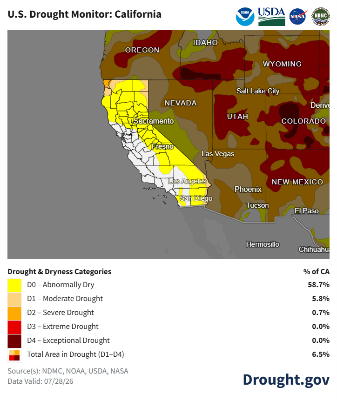
According to The California Drought Monitor “Current Drought Conditions for California – “As of July 28, 2026 approximately 6% (10,308 square miles) of California is under active drought conditions, with an additional 57% (92,864 square miles) classified as Abnormally Dry (D0).”
Keep aware of the drought conditions in your local area. There are many resources available from EPA, National Integrated Drought Information System, National Oceanic and Atmospheric Administration, U.S. Geological Survey, Drought.Gov and the California drought tracker map are just a few agencies to keep updated on current drought conditions.
It is better to mitigate drought by pre-planning efforts than to wait until the next drought begins. With the lack of precipitation already occurring statewide and with the volume of fires across California, it is only a matter of time.
What to do:
Conduct a Risk Assessment which will help identify vulnerable ground water sources, surface waters and reservoirs. Have resources available to help customers in drought prone areas. Encourage water conservation by implementing strategies such as only water certain days a week, do not wash cars in the driveway, and no outside irrigation. The State has available information and handouts that can be kept at the system office and distributed; it is important to involve the local community to address drought issues and get the buy-in needed to bring drought awareness to people. Lastly, develop a Drought Emergency Plan for water shortages. CRWA can assist in Drought Planning and has templates available.
|
|
|
System Spotlight: Indian Creek CSD
|
When Indian Creek Community Service District (ICCSD) needed help navigating the USDA Rural Development funding process, CRWA's Circuit Rider Program stepped in to provide hands-on technical assistance.
Serving 297 connections and approximately 1,030 residents near Bishop, ICCSD faced several challenges, including meeting California's residential metering requirements by 2032 and reducing rising pumping costs. Frustrated with the USDA application process, General Manager Terry Tye was considering withdrawing from the program.
CRWA Circuit Rider Abel Silva worked directly with USDA staff to clarify the application process, identify the next steps, and expand the funding request to include both a system-wide metering project and solar panel installation. He also connected the district with a CRWA Preferred Provider for additional metering support.
Thanks to CRWA's assistance, ICCSD is estimated to have saved approximately $3,500 in consulting and coordination costs. More importantly, the district regained confidence in moving forward with critical infrastructure improvements that will benefit the community for years to come.
|
|
|
Don't Panic—That Pink Film Is Common
|
|
If you've ever noticed a pink film around your sink, shower, toilet, or pet's water dish, you're not alone. This common occurrence is usually caused by Serratia marcescens, a naturally occurring bacteria found in the environment. It tends to grow in damp areas where soap residue, food particles, or other organic materials collect. The good news is that it does not survive in properly chlorinated drinking water and is not considered a waterborne disease. The easiest way to keep it under control is with routine cleaning and occasional disinfection using a chlorine bleach solution. Keeping bathrooms and other wet areas clean and dry will also help prevent it from returning.
|
|
|