Trouble viewing in your email client? View web version.
|
Water Workforce Development Tribune
|
CRWA & CLOW Hydrant/Valve Company Host Fee Workshop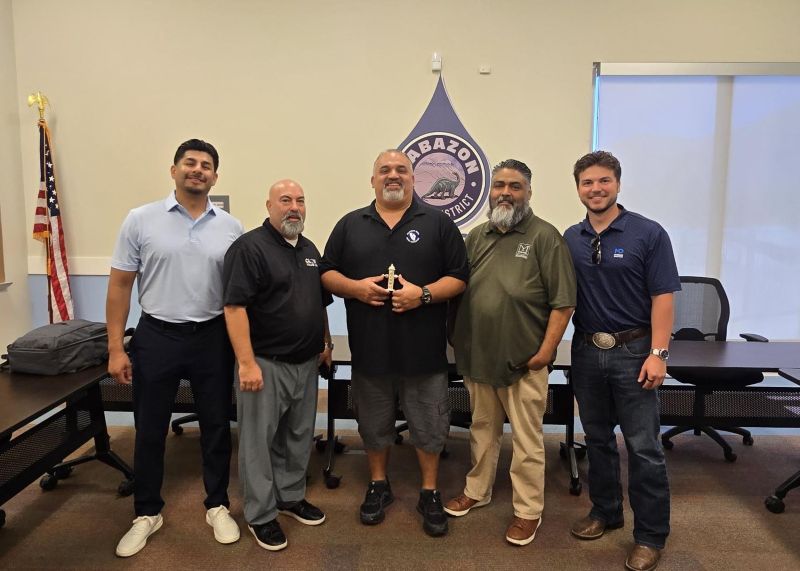
|
|
On August 19, 2026, the California Rural Water Association (CRWA), in partnership with CLOW Hydrant/Valve Company, hosted a Fee Workshop at the Cabazon Water District facility. The workshop provided four SWRCB contact hours, along with snacks, beverages, and a working lunch.
The workshop covered wet-barrel hydrant breakdown and reassembly, valves, and GPS leak detection. Instructors included Richard Ledesma and Chad Holt of CLOW, Wyatt Schrock of McWayne Ductile, and Juan Villanueva of Tyler Union.
CRWA would like to thank Cabazon Water District for hosting, as well as CLOW Valve and Hydrants, McWayne Ductile, and Tyler Union for their support. We also appreciate all the water systems that participated and continue to prioritize professional development and improved water system operations.
Many thanks to everyone who participated and contributed!
|
|
|
|
Upcoming Workforce Trainings
|
Distribution Certification Review 1-2
CRWA CLOSED SEPTEMBER 7th
Treatment Certification Review 1-2
Treatment Certification Review 1-2
| September 23-24, Morgan Hill |
Distribution Certification Review 1-2
| September 30 - October 1, San Jose |
Distribution Certification Review 1-2
| September 30 - October 1, Palmdale |
|
|
|
TRAINING SPOTLIGHT
|
|
September is packed with Certification Reviews all month long! You don't see one near you? Join our Hybrid Option and enjoy it from the comfort of your own system!
Distribution Certification Review 1-2
September 2nd - 3rd | Tulare
September 30th - October 1st | San Jose
CRWA’s intensive two-day review classes are designed to enhance your working knowledge of water distribution focusing on the grades 1-2 level.
Treatment Certification Review 1-2
September 9th- 10th | Buellton
September 23rd - 24th | Morgan Hill September 30th - October 1st | Palmdale
CRWA’s intensive two-day review classes are designed to enhance your working knowledge of water treatment and distribution. Each class includes a pre-test to assess your knowledge, in-depth instruction on essential topics, and practice exams to build confidence and test-taking skills.
|
|
Every Drop, Every System: Strengthening Cybersecurity in Rural Water
|
|
NRWA expands cybersecurity resources and partnerships to help rural utilities protect critical water infrastructure. Recent cyberattacks on water utilities have highlighted the growing cybersecurity threats facing the water sector. Small and rural systems can be particularly vulnerable due to limited staffing and resources, making preparedness and access to cybersecurity support more important than ever. The National Rural Water Association (NRWA) has responded by expanding programs, partnerships, training, and advocacy designed specifically to help rural water and wastewater utilities strengthen their cyber defenses. NRWA’s efforts include the Water Watch Center, a 24/7 cybersecurity monitoring and support hub, and the National Rural Water Cyber Security Center, which provides access to threat information, advisories, tools, and available services. NRWA has also partnered with WaterISAC to offer eligible systems serving 10,000 or fewer people free membership through December 31, 2026. Additional partnerships with DEF CON Project Franklin, the Cyber Readiness Institute, SANS Institute, and Dragos provide rural utilities with access to cybersecurity experts, training, and resources to help protect both information technology and operational technology. NRWA is also bringing cybersecurity assistance directly to rural utilities through its Cybersecurity Circuit Rider Program. In 2025, Circuit Riders worked onsite with more than 60 systems in Vermont and Oregon, helping utilities make practical improvements such as strengthening passwords, creating standard operating procedures, and developing emergency response plans. NRWA continues to advocate at the federal level for resources and policies that strengthen rural water cybersecurity. With threats continuing to evolve, rural utilities are encouraged to take advantage of these resources and partnerships. Protecting our nation’s water infrastructure starts with each system being prepared.
|
|
|
Ensuring Use of ELAP-Accredited Laboratories for Compliance Monitoring
|
|
State Water Resource Control Board:
This is a reminder to all public water systems of their regulatory responsibility to ensure that any laboratory used for drinking water compliance monitoring holds valid accreditation from the California Environmental Laboratory Accreditation Program (ELAP).
California regulations require that all drinking water compliance analyses be performed by laboratories accredited by ELAP for the specific analysis being conducted. This requirement is essential to ensure the validity, reliability, and regulatory acceptance of water quality data used to demonstrate compliance with health-based standards. Accordingly, water systems must verify a laboratory’s current ELAP accreditation for the specific method and analyte before using it for compliance monitoring.
Results from unaccredited laboratories cannot be used to meet regulatory requirements. Water systems utilizing unaccredited laboratories will be considered out of compliance with drinking water monitoring regulations, which may lead to enforcement actions and damage to public confidence.
Locate an ELAP-accredited Laboratory:
ELAP maintains an interactive GIS map on the right side of its web page to locate nearby accredited laboratories. Using the interactive map, individuals can search for an accredited laboratory by name, location, or certified field of testing. The California ELAP Certified Laboratories Map can be found: HERE
Use the Search Box to look for one near you or in a city
Use the zoom feature to zoom into a general area
Green circles O denote commercial certified laboratories
Use the filter in the top right of the map for broad category of analysis
Find out if the Selected Laboratory is Certified for the Analysis you Need:
Once you select a laboratory from the map, click on the circle
Contact information for the laboratory is displayed as well as the field of testing/Field of Accreditation List
The List provides a comprehensive list of the individual analyses the selected laboratory is certified to process as well as the expiration date for the certification
Contact the laboratory directly for both the Field of Accreditation List for the laboratory and any of the laboratory’s subcontracting laboratory(ies)
|
|
|
SB 552 Drought Planning for Small Water Suppliers and Rural Communities
|
|
According to the California Department of Water Resources (DWR), Senate Bill 552 (SB 552) requires small water suppliers—defined as those with fewer than 3,000 connections and serving fewer than 3,000 acre-feet—to develop an abridged Water Shortage Contingency Plan, annually report water supply conditions and monthly water use, and upgrade infrastructure to drought-resilient standards, if necessary. DWR and the State Water Resources Control Board worked together to develop templates for these abridged Water Shortage Contingency Plans. Two templates were created: one for small water suppliers and another specifically for schools that operate as a water system. The templates for the abridged Water Shortage Contingency Plans are now available on the DWR website. The available templates include: - Small Water Suppliers with 1,000–2,999 connections
- Nontransient Noncommunity (NTNC) Schools
These plans were required to be completed by July 1, 2023, posted on the water system’s website, and made available to the State Water Resources Control Board and the public upon request. Plans must also be updated every five years. For more information and access to the available templates, please refer to the California Department of Water Resources and State Water Resources Control Board websites.
|
|
|